


You work from home. You no longer attend church. You shop at Costco and barely know your neighbors, except when they notify you of misplaced Amazon packages. Past friend groups have faded. You spend evenings scrolling, watching, consuming. Your family loves you. You get lots of likes on life updates. You’re smart, prosperous, and fit enough. You don’t suffer from want. Life is good, convenient, even blessed.
But underneath, there’s a lurking emptiness.
Where do you belong? Where do you feel known, connected, and valued?
—
Last Monday was my birthday. As I sipped my morning cold brew, I reflected on all I’m grateful for in my life. Then, after counting my blessings, I let myself look at the gaps. One revealed itself with the suppressed force of a church organist’s latent homosexuality. What I’m missing is belonging.
This is not a “dear diary” post or a request for personal advice. I (mostly) know how to improve my sense of belonging, and I understand my personal obstacles: introversion, parental exhaustion, and an unhealthy mistrust of groups typical of latchkey Gen Xers like me. I’m sharing this because my ache may be yours too.
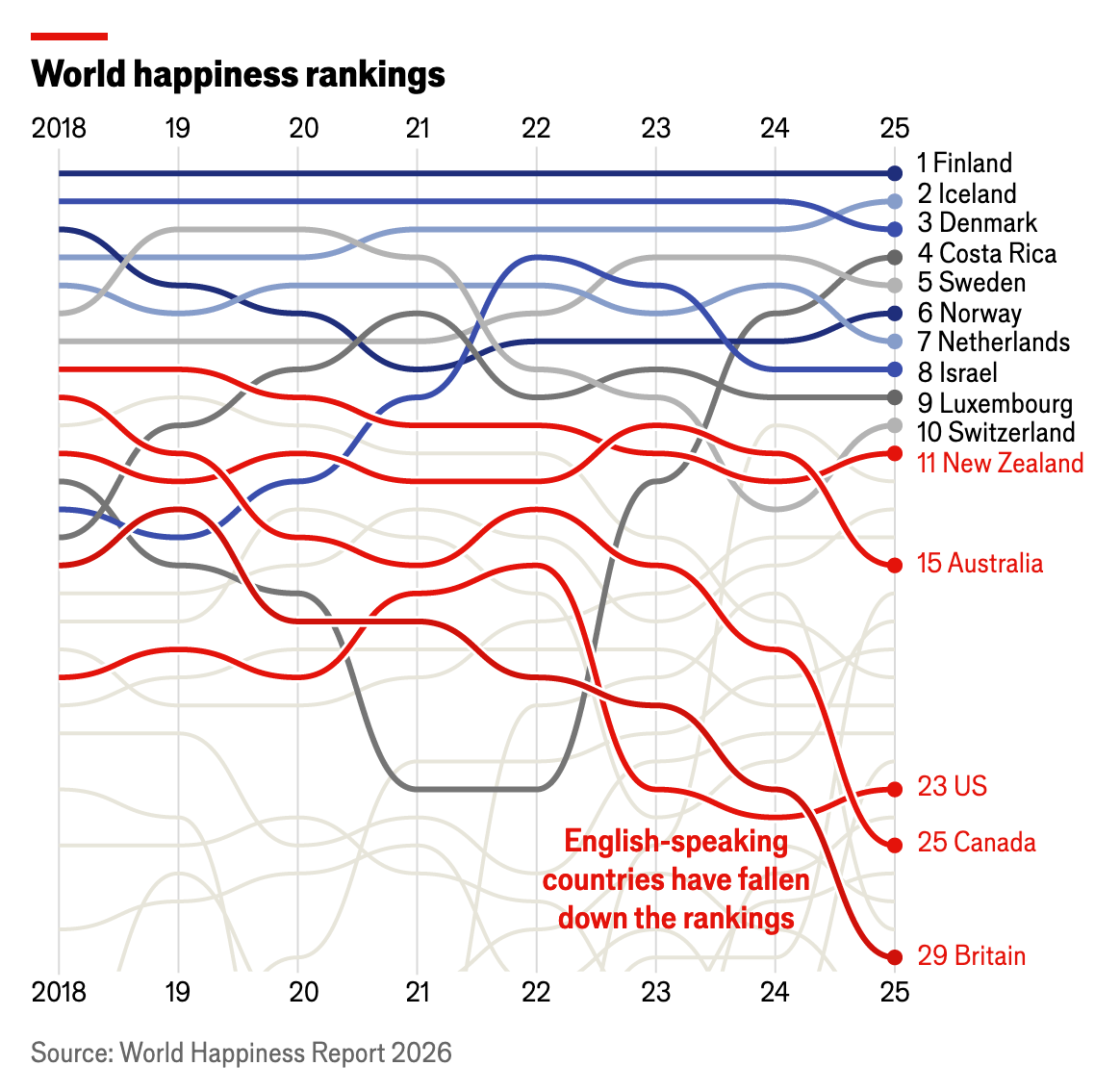
While much of our belonging is within our control, the structure of modern life makes it harder to achieve than in years past, especially for young people and middle-aged men like me. The freedoms and choices of modern life — to skip church, work remotely, socialize online — have come at the cost of dismantling the containers where most people found belonging. This may help explain why people in Anglosphere countries are more miserable than ever.
The media talks about a loneliness crisis. Philosophers talk about alienation. Both are real but intellectual cul-de-sacs. They describe symptoms, subjective emotions, rather than an underlying condition. Underneath them is something deeper and more structural. Many of us dare not even speak its name. We barely have the vocabulary for it. It feels like a vacancy in an otherwise full life, a room that looks great but doesn’t quite feel cozy.
“Belonging crisis” is the better frame. Loneliness and alienation describe what you feel. Belonging describes what you’re missing. If loneliness and alienation are tumors, lack of belonging is the cancer. Treating the tumor without diagnosing the cancer is just managing symptoms. That’s what society is doing now, cataloguing how pervasive loneliness is and moving on without looking at its roots.
Belonging forces a more structural diagnosis. Where do the children of Robert Putnam’s Bowling Alone and Charles Murray’s Coming Apart go? Where do they find belonging in a social fabric that’s been hollowed out and replaced by something more liquid and fragmented? Why does belonging today feel like a luxury good instead of the default?
Belonging has three components. It means being a known, connected, and valued member of a group, with the continuity and reciprocity that membership implies.
The times I’ve felt the most belonging are when I’ve been part of fellowship of any kind, a club, church, leadership program, even a longstanding group chat. Fellowships are containers for belonging, groups where people can be known, connect, and contribute. When I’m in one, I feel an inner glow and ease I don’t find anywhere else, even though part of me wants to rebel against it.
Part of why I’m feeling less belonging now is because I left a social group I was in for four years. I would regularly see people at weekly meetings. I felt liked, connected, and of service. It started feeling cultish toward the end, giving me flashbacks to the organized religion I was raised in. I left for that reason and others, and haven’t yet replaced the space it occupied in my life. Even as I remain friends with some members, I miss being part of the group. The irony isn’t lost on me that I did this to myself.
Without belonging, life can feel like school without homeroom. You have friends and acquaintances scattered everywhere but no container that holds you. You float socially. You have to take the initiative rather than entering a preexisting structure. You have to pursue friendship rather than letting friendship find you. Many middle-aged men aren’t good at that kind of pursuit. With work and kids and the demands of adult life, friendship is often the first to go.
My situation is particular, but the dynamic isn’t. For many people, belonging has become more episodic. It comes and goes with the structures that hold it and the commitments you make to it. The institutions where past generations found belonging are slipping away. The Elks, Masons, and Kiwanis — organizations that once gave millions of men a place to show up regularly and be known — have lost roughly three quarters of their members from their peak.1 Men today have fewer spaces for fellowship, and many of us aren’t good at building informal alternatives. Weekly church attendance has fallen from 42% to 30% in the last two decades.2
At the same time, modern life has become more disaggregated than ever, a trend accelerated by Covid. Remote work tripled since 2019.3 Homeschooling doubled.4 The number of full-time independent workers doubled.5 Gig work exploded too. Many of these changes have expanded freedom, flexibility, and choice. But they come at the cost of dismantling the containers where people found belonging. The same freedoms that liberated us individually have impoverished us collectively. I call this the Belonging Conundrum.
The atomization runs deeper than work, church, and school. Many activities that once required showing up somewhere with other people have been replaced by solo alternatives available 24/7. Sports betting moved from the track to the phone. Poker can be played against the computer. Even talking through your problems — once the work of friends, faith leaders, and group therapy — can be done with AI. I can lie in bed, naked and sleepless, and shitpost to strangers across the world. What all this “empowerment” means is that there are fewer reasons to show up anywhere and be known.
When I discussed this with a friend, he countered that there are more opportunities for belonging than ever today. He’s right. The same forces atomizing traditional containers for belonging are spawning entirely new ones. There are thousands of online communities, local running clubs, meetups, co-working spaces, group chats, and new churches and schools for every persuasion. There are even services like Time Left that host “weekly gatherings turning strangers into friends.” Belonging As A Service™.
Yet the belonging crisis is getting worse, not better. Opportunities for belonging are everywhere and nowhere. It’s no longer a byproduct of shared institutions and a common culture. You have to find and cultivate it on your own. In an atomized society, finding belonging takes real effort.
Today’s discourse about belonging is largely confined to HR departments and DEI offices, where it’s discussed in tandem with diversity and inclusion. I have to credit Pete Buttigieg, my smarter but smarmier gay-dad doppelganger, for highlighting a “crisis of belonging” in his 2020 presidential campaign. Like the McKinsey consultant he once was, he correctly identified the problem. But he failed to appreciate its full scope. His version was predictably filtered through identity politics, as if custom designed to resonate with the purple-haired attendees of the DNC and HRC. His speeches on belonging were full of throat-clearing sentences like, and I’m paraphrasing, “I know what it’s like to be a minority too” and “just because I’m gay doesn’t mean I know what it’s like to be a transgender woman of color.”6
Belonging needs to escape the capture of HR and identity politics. It’s a deeper, broader, and more sociologically rooted crisis than these frames suggest. It affects everyone, across income, ideology, and identity. And it shouldn’t code as partisan. Right now, the word is on the verge of inducing eye-rolls among my right-leaning friends, poisoned by the same progressive finger-wagging as “diversity.” I want to rescue it from that fate and make it something my friends can talk about matter of factly and without apology.
The belonging crisis has structural roots that cut across partisan lines. Hannah Arendt would diagnose it as the collapse of public life into the social realm, where algorithms and tribal grievance have replaced civic engagement. Others, from Christopher Lasch to Patrick Deneen, locate the problem at the heart of liberal universalism itself: when you belong everywhere, you belong nowhere.
Diagnosing the structural roots is important. But I don’t want to use that as an excuse. Like screen time, belonging is still an individual choice. I have more agency over my sense of belonging than I might want to admit. Cultivating belonging, I’m realizing, is a skill. It requires effort and practice. I could nurture existing friend groups more actively. I could join a new church or club. I could host dinner parties, volunteer at my son’s school, or get more involved with the Catherine Project. I could also build more belonging here on Substack, fostering community rather than just pontificating. The question is whether I’m willing to put in the work. Honestly, I haven’t yet decided what I’m going to do with my birthday revelation.
The collective answer is harder. It begins with reframing belonging as a public health issue, not a character flaw. Researchers should study it with the same rigor brought to loneliness and depression. Urban planners should treat it as a design problem, aiming for more pedestrian spaces, community centers, and recreational parks. Civic and fraternal organizations should stop dying gracefully and reinvent themselves for new generations. The containers for fellowship won’t build themselves. Someone has to decide they’re worth building and show up.
After my birthday coffee, I went to yoga for the first time in months. As I walked in, one of the yoga instructors lit up. “I was just thinking about you, Jeff. I’ve missed you. Welcome back.” I smiled and said hi back, accepting the minor birthday blessing.
This is the second in a series of essays building a philosophy of human flourishing in the age of AI. The first two are Dionysian Futurism and Convenience Is Killing Us.
Special thanks to Michael Dean for feedback on a draft.
Related Essays
Theme Song
Buttigieg is still talking about belonging but only in a pat, feel-good way. Speaking at the Harvard Kennedy School, he pointed to universities and the military as the primary institutions for building belonging. As he put it: “It creates an opportunity to scramble some of those other circles of belonging, with intergenerational encounters, geographic encounters, ideological diversity, and many other forms of diversity.” See Harvard Magazine article.
I’ve been puzzling over the loneliness discourse for several years now, watching it grow louder while struggling to square it with what I actually see around me. Reading this, I find myself in your friend’s shoes – the one who pushed back – because wherever I look I see abundant opportunities for friendship and fellowship. That gap, between the apparent abundance of opportunity and the reported epidemic of loneliness, is what I’ve been slowly working through. I think I’m getting closer to an answer.
The containers haven't collapsed. The Detroit Yacht Club, founded 1868, still exists. So does my theater club (founded in 1910), my neighborhood association, my synagogue. Book clubs, running clubs, volunteer opportunities at museums and food banks, none of this has disappeared. Old containers and new containers alike are still there, still accepting members, still generating exactly the fellowship you describe so well in your companion essay.
I'd suggest the crisis is less about supply than demand and you actually get close to the real mechanism when you describe activities that once required showing up somewhere being replaced by solo alternatives available 24/7. That's the key insight, and I think it goes further than you take it. The defining feature of modern life is the systematic elimination of friction. Streaming instead of the cinema. Delivery instead of the market. Sports betting on your phone instead of the track. AI instead of talking to a friend. Every one of these substitutes is inferior to the real thing for generating belonging, but they're frictionless and available immediately, and that combination is extraordinarily powerful at suppressing the motivation to do the harder thing. The book club still exists. The running club still exists. The door is open. But after a day of frictionless everything, the friction of coordinating, showing up, navigating the awkward early stages before fellowship kicks in.
I think sustained exposure to frictionless substitutes erodes the capacity to tolerate the friction that real belonging requires. People who grew up with low-friction social alternatives may never have built the muscle for it. The door is heavy for people who have never learned to push it, or who have grown so accustomed to doors that open automatically that they’ve forgotten pushing is an option.
In the fellowship essay you already demonstrate the supply thesis wrong in your own life: you walked into available institutions in Florida as a stranger and found fellowship waiting. That is a story about what happens when someone decides the friction is worth it. I think your fellowship essay is closer to the real answer than your structural diagnosis here.
Great article. I wonder how much of this is also that, alongside the physical fragmentation you lay out here very well, people are living almost in separate realities created by algorithms sycophantic to oneself. When there were only a few TV channels, I imagine everyone sort of watched and related on the same cultural events.
I would say that the thing in my life that combats this in deepest sense in my own life is church