


At bedtime, I tell myself I’m going to read a book. Instead I scroll Reels, watching one video after another. I tell myself the algorithm is feeding me valuable content, but it’s mostly slop. I watch anyway. Eventually, I nod off, worse off for it.
This is a small thing, but it points to something bigger than my obvious digital addiction. Convenience is killing us. Not with a bang but a thousand Uber Eats deliveries.
From the outside, the fully automated life looks amazing. Inside, it is hollow men. Everything is easy, available, and algorithmically optimized, like my phone at bedtime. That’s the problem. Eliminating all friction leads to fully automated misery. It’s like life under Covid lockdowns but by choice. Every purchase is on Amazon, every meeting by Zoom, and every conversation through a screen. Masked, sanitized, and alone.
After my last essay on belonging, Adam put his finger on the paradox of frictionlessness in the comments.1 He noted that institutions for belonging still exist, like yacht clubs and synagogues. The problem is demand. Then he described the mechanism:
The defining feature of modern life is the systematic elimination of friction. Streaming instead of the cinema. Delivery instead of the market. Sports betting on your phone instead of the track. AI instead of talking to a friend. Every one of these substitutes is inferior to the real thing for generating belonging, but they’re frictionless and available immediately, and that combination is powerful at suppressing the motivation to do the harder thing.
He was describing a trap I see in myself. Life gets so easy that it gets worse. We become so empowered that we lose the ability to act on our own.
Another reader, Chris Brandow, introduced the concept of satisficing, Herbert Simon’s term for choosing the good-enough option instead of the better one.2 You order Uber Eats instead of going to the local café. You Zoom instead of meeting in person. You scroll TikTok instead of reading a real book. You ask AI what to think instead of deciding yourself. Each choice makes sense in the moment. Taken together, they pull us toward atomization, dependency, and spiritual brain rot.
Part of what’s happening is a widening gap between first- and second-order desires. At bedtime, my lizard brain wants to scroll TikTok, but my higher-order self wants to read a paper-bound book. I want to want to read the book. But the allure of social media and short-form video makes it hard.
My higher-order desires are becoming frictionless too. I can access any book, lecture, or sermon instantly. Yet I read less, learn less, and barely pray. The gap between who I am and who I want to be is measured in regrettable minutes.
Consider two versions of the same day. In the frictionless version, groceries arrive at the door, dinner is delivered by Uber Eats, and I confess my problems to Claude rather than call my sister. Netflix plays “Members Only Palm Beach,” one vapid episode after another. Sensor lights activate when I enter a room. The Roborock keeps the floors clean. ChatGPT decides my outfits. I scroll Dave Ramsey videos until I nod off. Life is ordered, easy, clean, and vacant.
In the friction version, I walk to the coffeeshop, order cold brew, and make small talk with the college students behind the counter. I take my son to school instead of putting him on the bus. We talk about galaxies and axolotls, and I indulge him when he asks to play the slow version of “No Batidao” for the hundredth time. I take a long walk and let my mind wander, saying hi to those who pass. I call my sister or friend Aaron for advice. I meet friends for dinner at the local café. Before bed, I mark notes on Heidegger’s Question Concerning Technology instead of scrolling social media. I fall asleep tired but connected, my sleep deep and steady like a river.
For most of history, humans had to navigate scarcity. Basic needs like food and shelter took extreme amounts of effort. But today, life increasingly presents challenges of abundance. Our ancestors needed calories. Many today need Ozempic. The new challenge is saying no to excess, and nothing in our biology prepared us for this. Our lizard brains are wired to choose frictionlessness, and it’s leading to obesity, digital addiction, and loneliness. The evolutionary feedback loop hasn’t caught up to modern life. Where is my Ozempic for digital addiction?
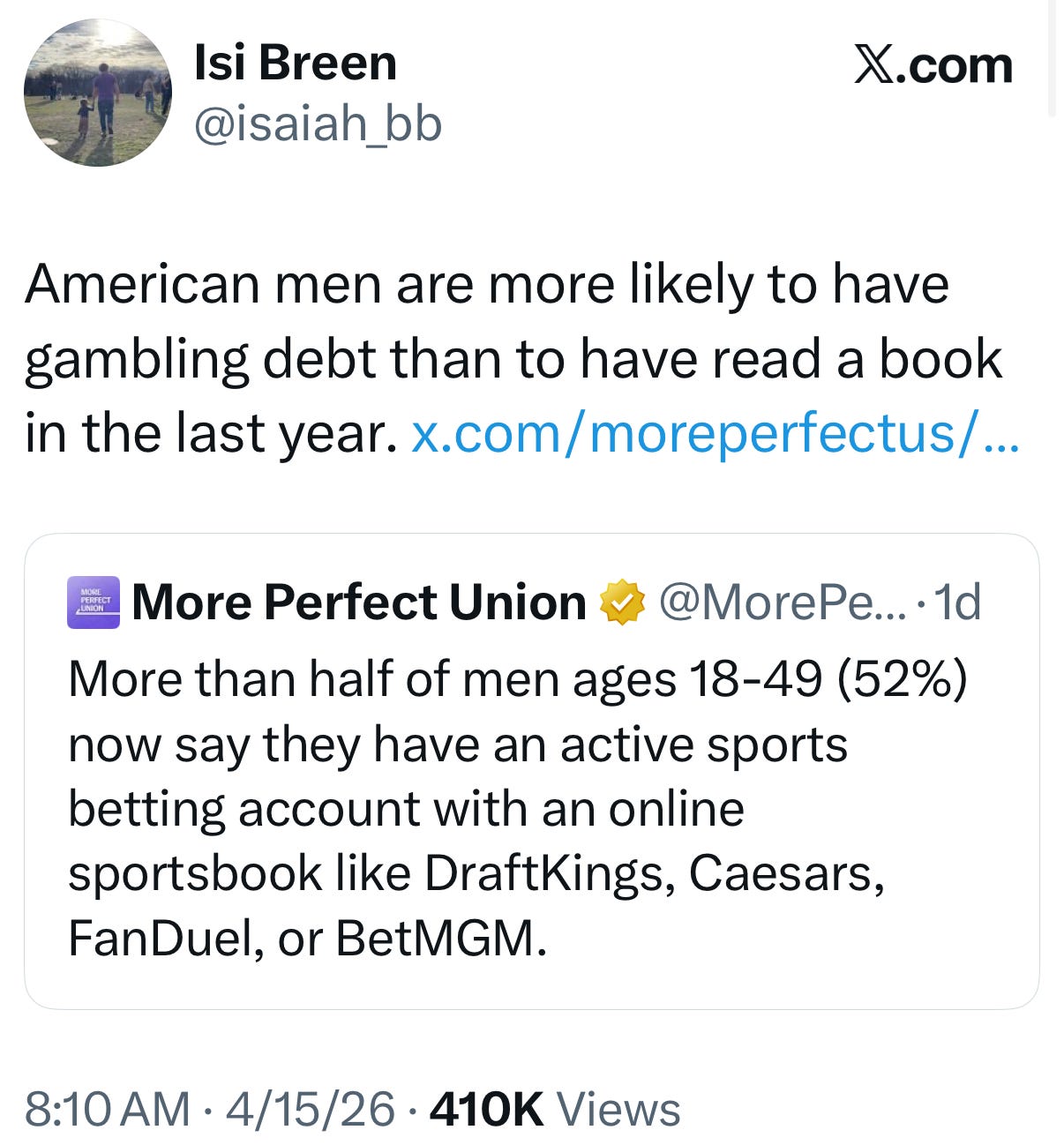
The result is what I call the substitution trap. Why go to the race track when you can place bets from your phone? Why go to the lecture when you can watch a video of it on your own time? Why go to the local men’s group when you can play video games online or post on Instagram? The frictionless alternative is always easier. You can see the effects among Gen Z, which has record rates of anxiety and depression.3 More than half of American men ages 18-49 now have an active online sports betting account,4 and nearly a third of bettors have gone into debt because of it.5 Frictionlessness is causing this, not relieving it.
The substitution trap also cuts us off from serendipity. It’s the unexpected conversation with the tattooed man sitting next to me at the restaurant,6 the random friend I make at yoga, the spark of the divine I feel at the choral concert. Serendipity and community are byproducts of friction. You can’t optimize your way to joy and belonging. Today’s hollow man never figures this out.
Frictionlessness poses civilizational threats too. Nobel Prize-winning economist Daron Acemoglu and colleagues recently found that if AI becomes capable enough, it can destroy society’s ability to generate new knowledge.7 Over-relying on AI for decision-making shifts learning incentives. Collective human intelligence depends on friction.
This isn’t an argument against technology or AI. I love automation. The question is what we choose to automate and why. Science fiction author Joanna Maciejewska put it best: “I want AI to do my laundry and dishes so that I can do art and writing, not for AI to do my art and writing so that I can do my laundry and dishes.”8 Deciding what to automate and what to protect is the most important act of agency in the AI era.
The pull toward fully automated misery isn’t inevitable. The corrective is what I call chosen friction, deliberately choosing the harder thing where it matters. The other half is self-management, which requires overruling the lizard brain and saying no. This is harder. Sometimes it means arranging life so the temptation isn’t even present. For me, that looks like having no ice cream in the freezer and, sigh, banishing my phone from the bedroom. My lizard brain experiences this as deprivation. My higher self recognizes it as agency.
The idea of choosing friction is already spreading. Ironically, I learned about this on TikTok. Some call it frictionmaxxing, the practice of choosing the less convenient option on purpose.9 Many people are recognizing that too much ease is harming them and reaching for correctives: hand-writing letters,10 paperback books,11 church,12 date night, in-person clubs. Frictionmaxxing would’ve sounded ridiculous even a decade ago, but today it resonates. That’s how new the problem is.
I’ve been thinking about how to consciously add friction to my own life. What do I need to remove, and what do I need to add? Some of this sparks resistance, making me feel a bit like Saint Augustine: Lord, take away my phone at bedtime… but not yet! Some of it gets me excited. I’m overdue for a long hike and drawn to the idea of pilgrimage. And some of it is clarifying. Parenting and caregiving are frictions I willingly choose.
Friction is the seed of thought and action. It is the origin of life itself.
This is the third in a series of essays building a philosophy of human flourishing in the age of AI. The first two are Dionysian Futurism and Nobody Belongs Anymore.
Special thanks to Melissa for helpful draft feedback.
Related Essays
Theme Song
I loved this by Charlie Becker.
Check out Michael Dean’s essay anthology.
One clear symptom of my need for friction - my handwriting, which I used to take great pride in, is falling apart.
Time to pick up the fountain pen, Leuchturm notebook and stationery again.
I realize that a question I posed recently to my friends is relevant to this article to some degree and it's this, "What is experientially better in our lives now, compared to ~1995 (ie. immediately pre-internet in normies' lives)"
There are definitely things to point to, but a lot of the improvements feel false somehow.
For example, we can watch any movie that has ever been filmed just by clicking a few pixels on a computer screen, though at the expense of communal movie-going as a regular practice. In terms of our the how we experience life, is that actually better?
Or, we can be in touch with any one of our friends and family at any moment via text or Facetime calls, or Facebook connection with high school classmates. But we are spending less and less time together in social gatherings with our geographically near friends.
I feel like these are really "old man yelling at sky"-coded and I'm definitely giving examples in a way that leans towards the negative, but I can't actually figure out if these aspects of life feel better or not.
It's also really hard to know what being middle aged person 30 years ago felt like, since I was in high school and college then.