

The Tech Oligarch's Paradox
When power outpaces legitimacy


Over the last several years, I’ve grown frustrated by a gap that feels more consequential than it first appears. Technology has never been more important — economically, militarily, and culturally — yet the people who sit at the very top of the tech world have become widely mistrusted, mocked, or feared.1 That disconnect feels like a serious threat to American progress and human flourishing.
In this kind of environment, proposals like California’s wealth tax aren’t just easier to pass; they become psychological vessels for sticking it to tech billionaires. Degrowth becomes fashionable. Political points are scored by bashing tech power. The result is self-sabotage fueled by scapegoating and schadenfreude. When punishing tech becomes a political win in itself, we all lose.
At first, I thought of this gap as a PR problem: how could tech leaders improve their public image? I went down that path for a while, imagining what a collective effort to rehabilitate their reputations might look like. But the more I thought about it, the clearer it became that PR is downstream from a much deeper issue: the legitimacy of power.
This is what I mean by the Tech Oligarch’s Paradox: tech power is outpacing its legitimacy. As a society, we’re deeply conflicted about tech power. We want the fruits of innovation but are uneasy about legitimizing the power that comes with it. We want the apps and rockets but not the people who produced them.
When power lacks legitimacy, people fight it instead of working with it. What should be coordination becomes conflict. That tension now defines the political landscape. One of the most pressing challenges we face today is finding an equilibrium that allows innovation to flourish without putting tech power permanently at odds with liberal democracy.
When power lacks legitimacy, people fight it instead of working with it. What should be coordination becomes conflict.
It’s fashionable to sneer at tech titans, and I understand why. I’ve written my own critiques of Elon Musk, Marc Andreessen, and the broligarchy. But I am firmly pro-technology and broadly pro-Silicon Valley. The tech sector is essential to American dynamism. Consider our economy. A third of the S&P 500’s market cap today comes from just seven tech companies. This means a huge amount of Americans’ retirement savings depends on the sector it’s now fashionable to attack.2
Without tech-driven productivity gains, we won’t survive the Long Boomer Farewell financially intact. Even with them, the odds are long. And without tech-enabled productivity, there’s no changing the math of an immigration-dependent political economy, which makes the reflexive anti-tech posture of some immigration hawks so baffling.
I want to make something clear: I view technology as a means to serve humanity, not as an end unto itself. I oppose utopian transhumanism and quasi-religious approaches to tech acceleration. I’m not here to cheerlead tech oligarchs. I understand why their power makes people uneasy, and they don’t do themselves any favors.
No one illustrates this paradox of tech power better than Elon Musk. We depend on him for rockets, satellite internet, critical infrastructure in space, and, whether we like it or not, ownership of one of the most influential digital public squares in the world. These are extraordinary accomplishments. And yet it’s hard to ignore how awkward his exercise of power can feel at times: capricious, theatrical, immature. When the quirks, blind spots, and online habits of tech oligarchs are this visible, it’s not surprising that people are uncomfortable with so much power concentrated in their hands, especially when those hands are actively reshaping the algorithmic foundations of modern life.3
Tech power is outpacing its legitimacy.
Part of the problem is that tech leaders never set out to be political actors. They were builders first, and many still treat politics as a distraction or contamination. But the scale of their success makes them political actors, whether they like it or not. Like the industrial titans of the nineteenth century, today’s tech CEOs have become soft rulers of society. Treating that power as incidental rather than accepting the responsibility that comes with it is Silicon Valley’s version of elite failure. Like it or not, you are the elite.
From the other side, tech oligarchs face their own bind. They can’t avoid politics anymore; their power looms too large. But the moment they engage politically, it often makes things worse. Engagement looks oligarchic unless it fits an agenda scripted by media and NGO elites. And let’s be honest: tech oligarchs aren’t good at politics. They’re too spectrumy, too focused on building real value, too impatient with the subtleties of perception and politicking, which feels fake and frivolous to them.
There’s also a deeper cultural problem at work. As Peter Thiel has pointed out, American society has grown uncomfortable with the idea of heroes altogether.4 A society that cannot acknowledge great achievements will struggle to legitimate the power that produces them, even when it depends on them. Elon Musk may be polarizing, but the scale of what he’s built would have been unambiguously heroic in an earlier era.
Yes, there’s a cultural issue, but tech oligarchs still need to act. So what should they do, short of pretending they don’t wield power at all?
If I were channeling my inner Machiavelli and giving them advice, I’d put it this way, borrowing James Carville’s phrasing: it’s the legitimacy, stupid. Building legitimacy is not a problem someone else is going to solve for tech leaders. They have to address it themselves, proactively. Rather than complaining about other elites, tech oligarchs must become the elite they wish to see.
My exhortation to them is to pursue legitimacy, not cynically or manipulatively, but as a genuine project. What does that look like in practice?
Rather than complaining about other elites, tech oligarchs must become the elite they wish to see.
First, power needs institutions, not just personalities. Personal power is unstable and frightening. Institutional power absorbs blame, creates continuity, and feels less arbitrary. History teaches this lesson repeatedly: the more power is concentrated in individuals, the easier it is to attack.5
Second, governance matters. When decisions feel like they flow from one person at the top — as many policies on X do — they feel illegitimate even when defensible. Transparent rules, procedures, and review structures make authority intelligible. Facebook has moved in this direction with its Oversight Board.
Third, tech needs to speak moral language plainly and without embarrassment. It needs to care. People want to know how tech power benefits society, what tradeoffs it imposes, and why those tradeoffs are justified. When tech refuses to make its own case, others will do it for them less charitably.
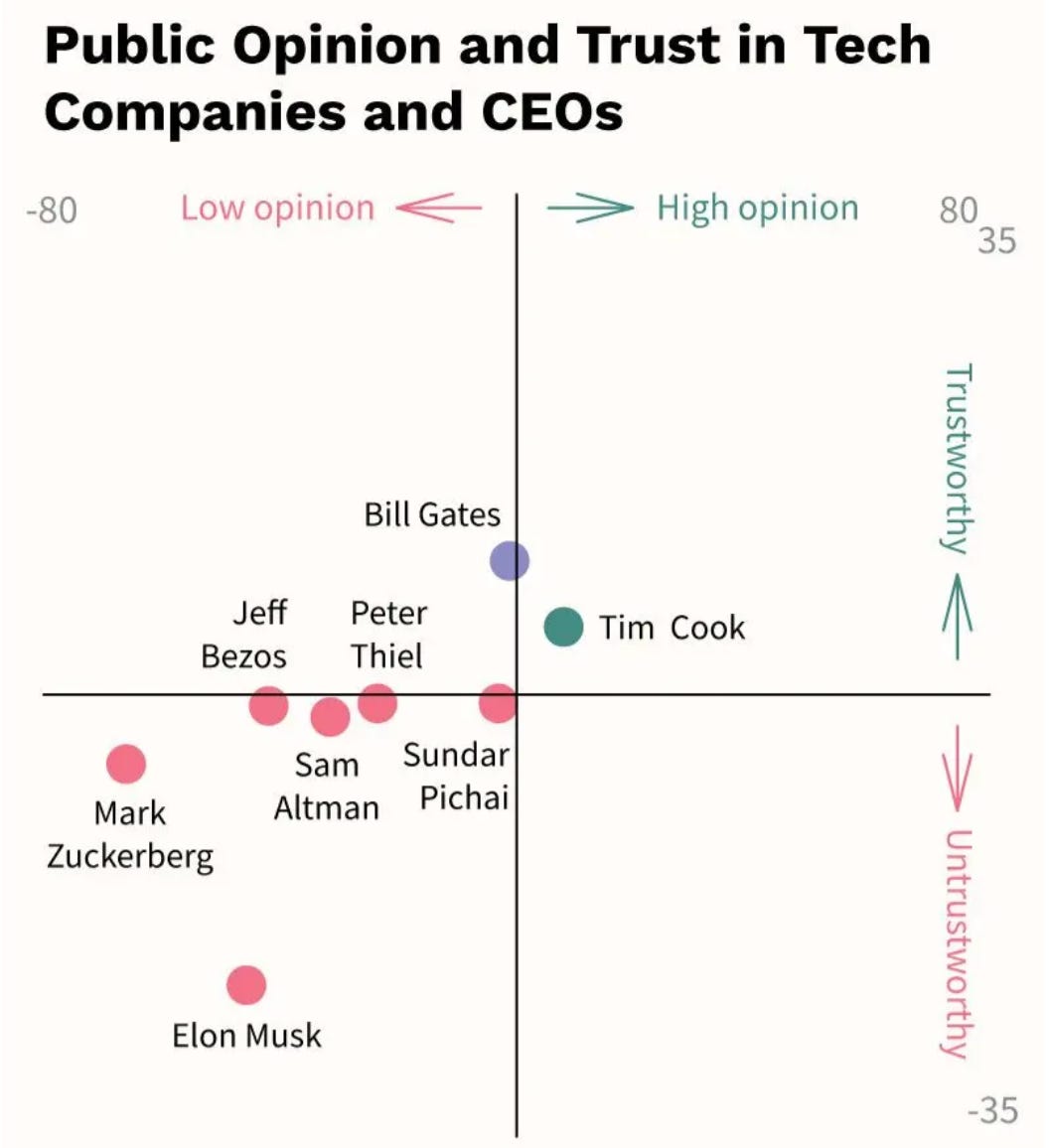
Fourth, trust needs to be built and preserved carefully, recognizing how quickly it can be burned. We’re living through a broad trust crisis that touches all institutions and elites. Tech leaders are not exempt. No amount of value-creation translates into trust; otherwise Musk would be more trusted. It’s notable that the most trusted leader in tech is Tim Cook, a professional CEO rather than a founder-turned-CEO.
Fifth, philanthropy grounded in genuine civic virtue can be a path to legitimacy. Tech leaders can be grandiose about humanity in the abstract while remaining disconnected from people in their own backyards. Philanthropy offers a way to invest wealth in communities and causes closer at hand. People want to feel you care.
Sixth, legitimacy has to be demonstrated — performed — before it can be earned. Tech leaders may bristle at this, seeing it as fake. But even Silicon Valley has a phrase for this: fake it till you make it. In politics, as in business, performance is the first step toward reality.
Power is never rationalized once and for all. It evolves. A century ago, Americans depended on industrial titans like Ford, Rockefeller, and Morgan. We feared their power too. Over time, society constrained, institutionalized, and partially legitimized their power. It wasn’t clean or painless, but it happened.
That’s the negotiation we’re in now with technological power. We haven’t yet agreed on how to legitimate it. Left unresolved, this tension ends in self-sabotage, as society slowly suffocates its most productive sector, harming all of us.
The legitimacy of tech power must be cultivated deliberately and proactively. The current situation is not a stable foundation for the future we’re trying to build.
Related Essays
Theme Song
The Magnificent Seven made up 34% of the S&P 500’s value in January 2026. See this Motley Fool article.
Do we really want the guy who constantly retweets the “insights” of Ian Miles Cheong controlling our space program?
See this Hoover Institute conversation
Years ago, when I worked at Koch Industries, I helped the CEO develop an “anti-predation” strategy. This was a major take-away.
Very thought provoking. We see the distrustful (scornful, even) pattern you point out over and over. Lately, it's conspiracy theories about RAM shortages. AI oligarchs are hoarding RAM to resell at astronomical prices, or to keep people from having adequate computers so they have to rely on subscriptions to cloud delivery services.
On and on it goes.
Huge bonus points for closing with "Everybody Wants To Rule The World,' a top 5 song from the 80s.
No one questions the importance or contribution of scientists and inventors (and the people who invest in them) to the advancement of technology in this country. It’s how they use that power, that leverage, that matters and how accountable they are for the decisions they make that impacts their users. Are they using their wealth and platforms to influence elections, lobbying, and policy, sometimes acting as "broligarchs" that shape government actions and benefit themselves? Or is their wealth being used primarily to solve, (or attempt to solve), long-term, existential, or technological challenges that would benefit all of society?